19/08/2026
5 Reasons Why Himalayan Red Rajma Tastes Better Than Regular Rajma
Natural Farm Essentials
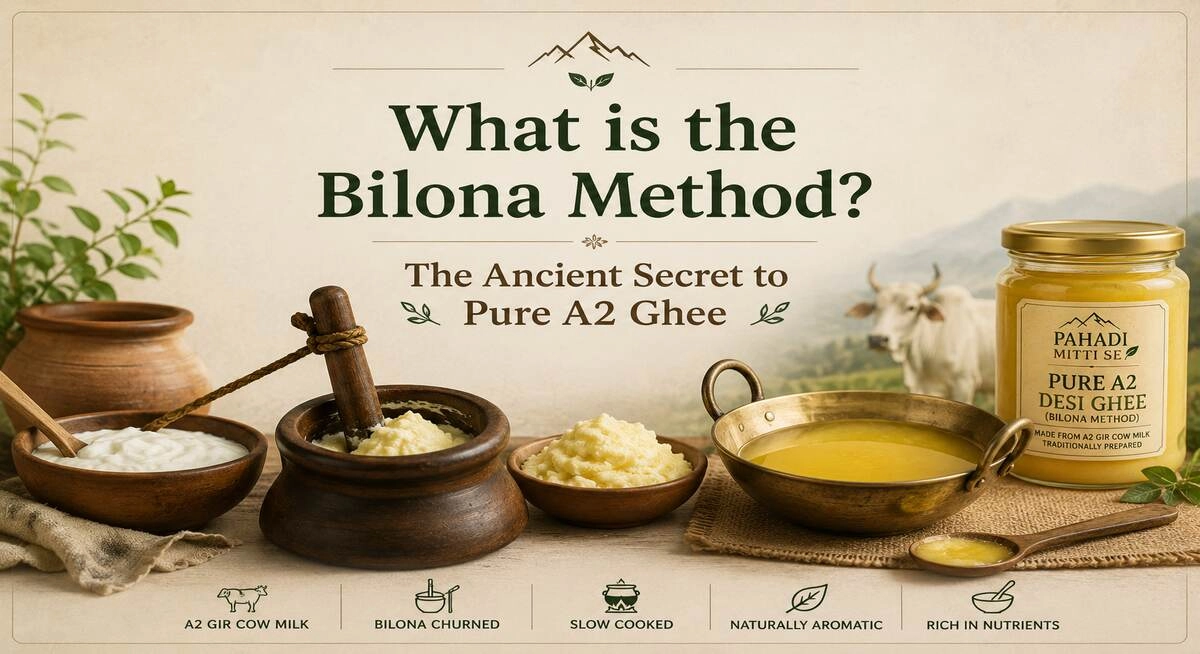
What is the Bilona Method? The Ancient Secret to Pure A2 Ghee
by Admin
19/08/2026
6 min read
Before modern dairy processing transformed the way we make ghee, Indian households followed a slower, more traditional approach.
Milk was turned into curd. The curd was churned to obtain butter. The butter was then slowly heated until it became fragrant, golden ghee.
This traditional process is known as the Bilona Method.
Today, Bilona ghee has become increasingly valued by people looking for traditional Indian foods prepared with patience and care. At Pahadi Mitti Se, our Pure A2 Desi Ghee is traditionally prepared using the Bilona method from A2 milk of free-grazing Gir cows and made in small batches.
But what exactly makes the Bilona method different?
Let's take a closer look.
What is the Bilona Method?
The word Bilona refers to the traditional process of churning curd to separate butter.
Unlike the modern cream-separation approach commonly used in commercial dairy processing, the traditional Bilona process begins with whole milk.
The milk is first converted into curd, the curd is churned to extract makkhan (butter), and the butter is then gently heated to produce ghee.
It is a process that takes more time—but that time is part of what gives traditionally prepared ghee its distinctive aroma, grainy texture, golden appearance, and rich flavour.
How is A2 Bilona Ghee Made?
The beauty of Bilona ghee lies in the journey from milk to ghee.
Step 1: Fresh Desi Cow Milk
The process begins with milk from indigenous desi cows. Pahadi Mitti Se describes its A2 Desi Ghee as being made from A2 milk of free-grazing Gir cows.
The quality of the final ghee begins with the quality and sourcing of the milk.
Step 2: Milk is Converted into Curd
Rather than separating cream first, the milk is traditionally allowed to ferment into curd.
This is an important part of the Bilona process because the butter is obtained by churning the curd itself.
Step 3: Traditional Churning
The curd is churned using a traditional bilona, traditionally a wooden churning tool.
This slow churning separates the butter from the buttermilk.
The freshly obtained butter, or makkhan, is then collected for the next stage.
Step 4: Slow Heating of Butter
The butter is gently heated over a controlled flame.
As it cooks, moisture evaporates and the milk solids separate. Gradually, the butter transforms into clear, golden ghee with its characteristic rich aroma.
This is where patience matters.
Step 5: Filtration and Storage
Once the ghee reaches the desired stage, it is carefully filtered to separate the remaining milk solids.
The finished ghee is then stored and packed to preserve its quality and freshness.
Milk → Curd → Churning → Makkhan → Slow Heating → Ghee
That is the essence of the traditional Bilona journey.
Why is Bilona Ghee Different?
The biggest difference isn't simply the name.
It is the method.
Traditional Bilona preparation is more time-intensive than many modern production methods. It involves multiple stages and requires careful handling at each step.
This traditional approach can contribute to the qualities people associate with good Bilona ghee:
🌿 Rich Natural Aroma
A distinctive, warm and buttery fragrance.
🧈 Traditional Grainy Texture
Authentically prepared ghee can develop a characteristic granular or grainy texture.
🌕 Golden Appearance
Pure desi ghee naturally develops a beautiful golden colour.
🥄 Deep, Rich Flavour
A small spoonful can add depth and richness to dal, rice, roti and other dishes.
🏺 Traditional Preparation
The process preserves an age-old Indian food-making tradition.
Pahadi Mitti Se specifically describes its A2 Desi Ghee as traditionally prepared, made in small batches, and valued for its natural aroma and rich texture.
What Does “A2” Mean?
The term A2 refers to a type of beta-casein protein found in milk.
Some indigenous Indian cattle breeds produce milk containing predominantly A2 beta-casein, although the nutritional and health implications of A1 versus A2 milk are an area of ongoing scientific research.
Therefore, A2 should not be treated as a guarantee of specific health benefits.
What makes A2 Bilona Ghee particularly interesting is the combination of desi cow milk + traditional Bilona preparation.
Is A2 Bilona Ghee Good for Everyday Cooking?
Ghee has been part of Indian kitchens for centuries.
Its rich flavour makes it incredibly versatile.
You can use a small amount of ghee for:
Dal & Rice
Add a spoonful of ghee to hot dal or rice for an instantly richer aroma and flavour.
Roti & Paratha
A light spread of ghee over warm roti or paratha creates a simple, traditional combination.
Khichdi
Few things are more comforting than warm khichdi finished with a little desi ghee.
Indian Sweets
Ghee is an essential ingredient in many traditional Indian sweets and festive recipes.
Everyday Cooking
It can also be used in cooking and tempering, depending on the recipe and your dietary preferences.
As with any concentrated fat, moderation is important.
Bilona Ghee and Indian Food Heritage
There is something beautiful about traditional food methods.
They remind us that food is not only about convenience—it is also about time, skill, patience and connection to tradition.
The Bilona method represents this philosophy perfectly.
It transforms a simple ingredient like milk through a sequence of traditional steps, each contributing to the final product.
This connection to traditional knowledge is closely aligned with the philosophy of Pahadi Mitti Se, which aims to preserve the stories, practices and food traditions connected to Himalayan and regional communities while making authentic products more accessible to modern households.
Why Choose Pahadi Mitti Se Pure A2 Desi Ghee?
At Pahadi Mitti Se, the focus is on traditional preparation and natural goodness rather than shortcuts.
Our Pure A2 Desi Ghee is:
🐄 Made from A2 Gir Cow Milk
Prepared using milk from indigenous Gir cows.
🧈 Traditionally Bilona Churned
Curd is traditionally churned to obtain butter before making ghee.
🔥 Slowly Prepared
Butter is gently heated to transform it into aromatic ghee.
🌿 Made in Small Batches
Small-batch preparation allows careful handling throughout the process.
✨ Naturally Aromatic
Known for its rich, traditional aroma and flavour.
🥣 Versatile for Everyday Use
Ideal for dal, rice, roti, paratha, khichdi and traditional Indian recipes.
Bilona Ghee: More Than Just Ghee
In a world where everything is becoming faster, the Bilona method reminds us of the value of slowing down.
It is not simply about making ghee.
It is about following a traditional process, respecting the ingredient, and allowing time to do its work.
From fresh milk to curd, from curd to makkhan, and from makkhan to golden ghee—the journey itself is what makes Bilona special.
Pure A2 Desi Ghee by Pahadi Mitti Se brings this traditional Indian food heritage closer to your modern kitchen.
A little tradition.
A little patience.
A lot of flavour.
Pahadi Mitti Se — Purely Himalayan. Truly Natural.
Categories
Popular Posts
 NEW
NEW
 NEW
NEW
 NEW
NEW
Natural Farm Essentials
Natural Farm Essentials
Natural Farm Essentials
Natural Farm Essentials